
Weaving a Stronger Web
What a spider's web taught me about inquiry, uncertainty, and the courage to keep asking questions

I’ve always had an odd relationship with spiders. If I’m being honest, the mere sight of most of them completely freaks me out.
Having been bitten twice by white-tails over the years, my fear has metastasized into what I would call a healthy sense of paranoia. One of those bites happened in Australia a few years ago. I woke up in the middle of the night, feeling something crawling along at the nape of my neck. In what was almost certainly a wildly jerky and awkward moment, I aggressively swiped it off with the back of my hand. Jumping out of bed and turning the light on, I saw a large white-tail on the carpet beside me.
While I don’t usually advocate for killing spiders, right then my instincts took over. Doing what I imagine most Aussies would do in this situation, I grabbed my nearby thong1 and finished it off. The bite it left on the back of my neck was incredibly itchy and still flares up occasionally when my body is under stress.
Growing up in Australia means that spiders aren’t a rarity, they’re literally everywhere. We find many different species in our gardens, lurking around our sheds and sometimes even taking a swim in the pool. They enjoy making webs on our washing lines which means they also make their way into our washing baskets, and occasionally they crawl into bed with us too. We live alongside them whether we like it or not.
Australia is a land of spiders.
Yet, despite all of this, I find them totally fascinating. I have sat and watched as a daddy-long-legs makes a meal out of a house spider. When huntsmen have found their way inside the house, I’ve often affectionately named them ‘Harry’ or ‘Henrietta’, something most of us tend to do in Australia. I love seeing the symmetry of a web catching the morning sunlight. The intricate architecture of their bodies is more perfectly designed than anything human hands could produce. On top of that, the sheer variety of species and the fact that these creatures have survived for hundreds of millions of years, and continue to thrive almost everywhere on Earth, is both mind boggling and humbling. It is safe to say that I find spiders unsettling and beautiful at the same time.
There are plenty of spiders in Thailand too, although in Bangkok I don’t seem to come across them very often. This week though, I found a tiny little spider web in one of my balcony plants and as I looked closely at its perfectly miniature architecture, I found myself thinking about Robert Frost’s poem Design.
I found a dimpled spider, fat and white,
On a white heal-all, holding up a moth
Like a white piece of rigid satin cloth--
Assorted characters of death and blight
Mixed ready to begin the morning right,
Like the ingredients of a witches’ broth--
A snow-drop spider, a flower like a froth,
And dead wings carried like a paper kite.What had that flower to do with being white,
The wayside blue and innocent heal-all?
What brought the kindred spider to that height,
Then steered the white moth thither in the night?
What but design of darkness to appall?—
If design govern in a thing so small.
The poem is not one of his more cheerful works, but it is one that stayed with me. Frost begins with a simple observation: a white spider on a white flower holding a white moth. He notices a pattern and starts asking questions. Was it a coincidence? Was it convergence? Or was it something more? I feel like the poem becomes increasingly unsettling because Frost never quite settles on an answer. Instead, he sits with the uncertainty, following the questions wherever they lead.
That feels familiar and the more I thought about it, the more the connections in my thinking began to emerge.
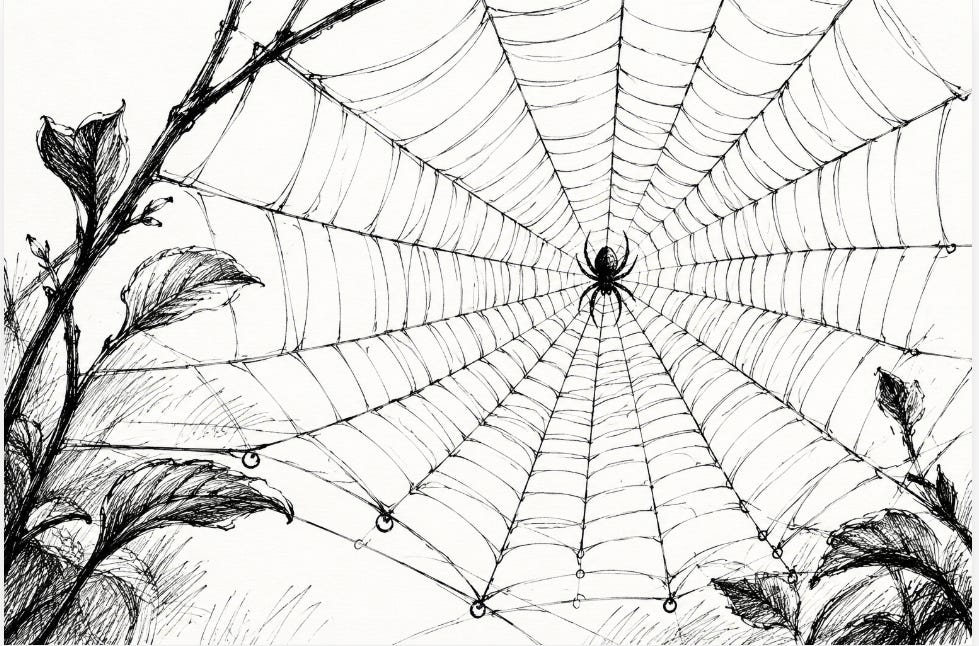
The web in front of me stopped being just a physical structure. It told a story of mathematics and symmetry, of biology and evolution. It was a tiny wonder of engineering and design. It connected me to both storytelling and metaphor - the spider has featured in cultural narratives around the world as a powerful symbol of good, of evil and often, of wisdom.
It also reminded me that indigenous peoples across the globe have used spiders as a way of observing, connecting to, and sharing knowledge of the natural world over tens of thousands of years, by paying close attention to these tiny creatures that share Country with us. A single spider and its web has been quietly connecting literature, science, mathematics, history and culture.
That’s when I realised that my own thoughts about the spider and its web were starting to form a metaphor of my own.
One of the most persistent misconceptions about inquiry-based learning is that it lacks rigour. I’ve heard many dismiss it as ‘just play’ or express the concern that inquiry is about children simply following their interests without any genuine direction or discipline. My experience, both as a teacher and as a learner, has been the exact opposite. Inquiry doesn’t reduce rigour. It takes it to a whole new level of engagement.
When we genuinely inquire into something, we rarely remain neatly inside a single topic or subject area. Instead, inquiry requires us to move between disciplines, to make connections between a range of skills and knowledge and most importantly, it invites us to bring our prior understandings, experiences and questions along with us. Learning becomes richer because it relates more closely to the reality of how human brains process the information we gather about the world around us. That world is not organised into curriculum boxes.
I have seen inquiry in action every time my students discover one of the tiny jumping spiders which inhabit their school playgrounds. Unlike the white-tails that have created my paranoia over spiders in Australia, these little guys seem almost friendly. The children become mesmerised by them, leaning in to examine them with curiosity and wonder in their expressions.
Then the questions start flying almost immediately: Why do they jump? How many different kinds are there? Do spiders sleep? What do they eat? Are there spiders in every country? Before long we’re wandering into deep discussions about ecosystems, adaptation, geography, behaviour and classification. Nobody has announced that playtime just became a science lesson. Nobody has informed the children that their questions have wandered into biology. They’re simply doing what children do naturally and following their curiosity.
The point of inquiry isn’t walking away holding all of the answers. The point of inquiry is refusing to stop asking the questions that intrigue us.
That idea followed me into my own learning this week. I had originally planned to write about a topic that I thought I understood pretty well. I’ve been researching covert global power structures and, at some point this week, became convinced that I had found a connection between a historical organisation and a more modern one operating insidiously in Australian life right now. Like Frost, I had noticed a pattern. At least, I thought I had.
The more closely I examined the evidence, however, the more apparent it became that I had misunderstood what I was looking at. The connection wasn’t what I thought it was at all. For a moment, I felt frustrated. Then curiosity took over. If these things weren’t connected in the way I’d assumed, what was I missing? What other questions needed asking? What did the evidence actually suggest?
The roadblock wasn’t a sign that inquiry had failed. It was inquiry working exactly as intended, moving me from observation to pattern recognition to harder questions. The real challenge wasn’t finding an answer. It was resisting the temptation to force the evidence to fit the story I had already constructed.
As a historian, this feels familiar. As my friends and family would freely tell you, I hold plenty of strong views. I make judgements. I reach conclusions. I am as capable of bias as anyone else. The difference is that history has taught me to leave room for those conclusions to change. To be a ‘truth-teller’, every interpretation needs to remain open to challenge and every argument open to revision in the face of new evidence. Inquiry demands exactly the same thing. It asks us to sit with discomfort. To embrace complexity. To tolerate uncertainty. To acknowledge when we are wrong and to keep going until we find the truth.
That realisation struck me once more as I worked with some classmates during a Thai lesson a few days ago. We were practising simple conversational questions, one of which was: What books do you enjoy reading? One member of the group replied, “I only read the Bible.” I won’t lie, my reaction was slightly stunned - not because she was religious. I have plenty of friends who are deeply religious; some attend Bible study groups, others Quran study groups, many read sacred texts regularly. What struck me about this response wasn’t the intensity of her faith at all. Rather, it was being confronted with the concept of relying on just one religious text in order to shape an identity and form a view of the complex world that we all share.
As a historian, teacher and former librarian, I found myself struggling to make sense of it. Both my personal and professional lives have been built around a very different set of assumptions: that understanding grows when we engage with multiple sources, perspectives and experiences; that it is our responsibility to one another to develop compassion by honouring a range of stories and beliefs; and that learning only truly happens when we are open to examining our own assumptions through comparison, contradiction, corroboration and dialogue.
A worldview which is built while relying on a single source produces an inflexible and narrow thread. Inquiry on the other hand, builds webs.
Perhaps that is why inquiry feels so important at this particular moment in the history of humanity. We are living through a period of polarisation and increasing certainty as we divide ourselves accordingly into tribes - political tribes, ideological tribes, religious tribes, algorithmic tribes. Everywhere we look, there are forces encouraging us to retreat into familiar narratives and to invest our loyalty in communities which feel ideologically ‘safe’.
Yet the innately human condition of empathy requires us to encounter perspectives beyond our own. Belonging requires us to understand people whose experiences differ from ours. Democracy requires citizens who are not only capable of questioning information, but who can evaluate a range of evidence and use this to revise their existing views when new facts emerge - even when those facts may upset what we previously believed to be true. None of this is possible without engaging in the process of inquiry. None of it happens without cultivating a sense of curiosity about the world and its inhabitants. Critically, none of it happens if we resolve to abandon inquiry the second it throws up anything which makes us uncomfortable.
Once again, this brings me to another story about an encounter with a spider. Almost fifteen years ago, while standing in front of a classroom in London, I held a tarantula. This was absolutely not a personal choice, but one I made because my students had decided that I was the bravest teacher in the room and so had nominated me to do it. They didn’t know that this was one of my greatest fears, but rather than making a fuss, I sucked it up and allowed its owner to gently place her in my hand.
What surprised me wasn’t that I survived the encounter without totally losing it in front of my Year 7s and 8s - it was what I noticed. She was much heavier than I expected her to be. When she moved across my hands, I could feel each tiny footstep through the sticky little pads at the end of each one of her legs. She wasn’t actually that scary at all, in fact, she was gentle. Careful. Almost sweet. While that experience hasn’t removed my fear, it absolutely changed my relationship with it.
That’s what inquiry offers us. We don’t always walk away with certainty, it doesn’t always bring us comfort, and we definitely don’t always find neat or easy answers. Instead, embracing inquiry leads us to developing a deeper understanding of the things that unsettle us. It cultivates the courage to keep asking questions. It helps us to develop the humility to acknowledge when we are wrong, and to change our minds. Most importantly, it reminds us that having the willingness to follow the thread a little further is what truly opens up the world around us.
The spider, the poem, the students, the research roadblock, the woman in my Thai class - they all point to the same lesson. Learning is not about finding a single answer and holding onto it forever.
It’s about weaving a stronger web. One connection at a time.
For all the non-Aussies, a ‘thong’ is what you might call a ‘flip-flop’, a ‘slipper’ or for my NZ crew, a ‘jandal’.
“When we genuinely inquire into something, we rarely remain neatly inside a single topic or subject area. Instead, inquiry requires us to move between disciplines, to make connections between a range of skills and knowledge and most importantly, it invites us to bring our prior understandings, experiences and questions along with us. Learning becomes richer because it relates more closely to the reality of how human brains process the information we gather about the world around us. That world is not organised into curriculum boxes.”
I have been trying to find the words to express my own thoughts about inquiry based learning, as well as problem based learning. (Both are similar, but have their own niches). I prefer them over explicitly using explicit teaching.
I believe and am working on how to show the explicit teaching embedded in inquiry- and problem- based teaching. Yet when I try to defend my arguments, those who are for the I Do, We Do, You Do; just do not want to listen.
Loved this… learning mathematics is rather like what you say: “ To be a ‘truth-teller’, every interpretation needs to remain open to challenge and every argument open to revision in the face of new evidence.” Except that what you call ‘evidence’ is better described as ‘what is inconsistent’ and doesn’t stand up to rigour… what will cause what you think to break down in the face of further thought. In this sense mathematics is a set of truth procedures. Being good at mathematics… near perfect at school level… led me into trouble as I started to discover a world filled with dishonesty and inconvenient truths that a person was asked not to question. For this very reason we must demand a better world that lives up to what we are taught when we are taught to think about ideas and to interpret. I do believe that young people of today will demand this!